
Categories
Trending

“Then I Realized What It Is, There’s a Man” Trend Explained

The viral TikTok audio originates from a scene in the 2001 David Lynch film Mulholland Drive, where a character named Dan tells his therapist about a disturbing dream he had involving the diner where they are speaking.

In the dream, both of them are in the diner and feel intimidated. Dan becomes even more frightened when he notices how scared his therapist is. He then says, “Then I realized what it is. There’s a man…”

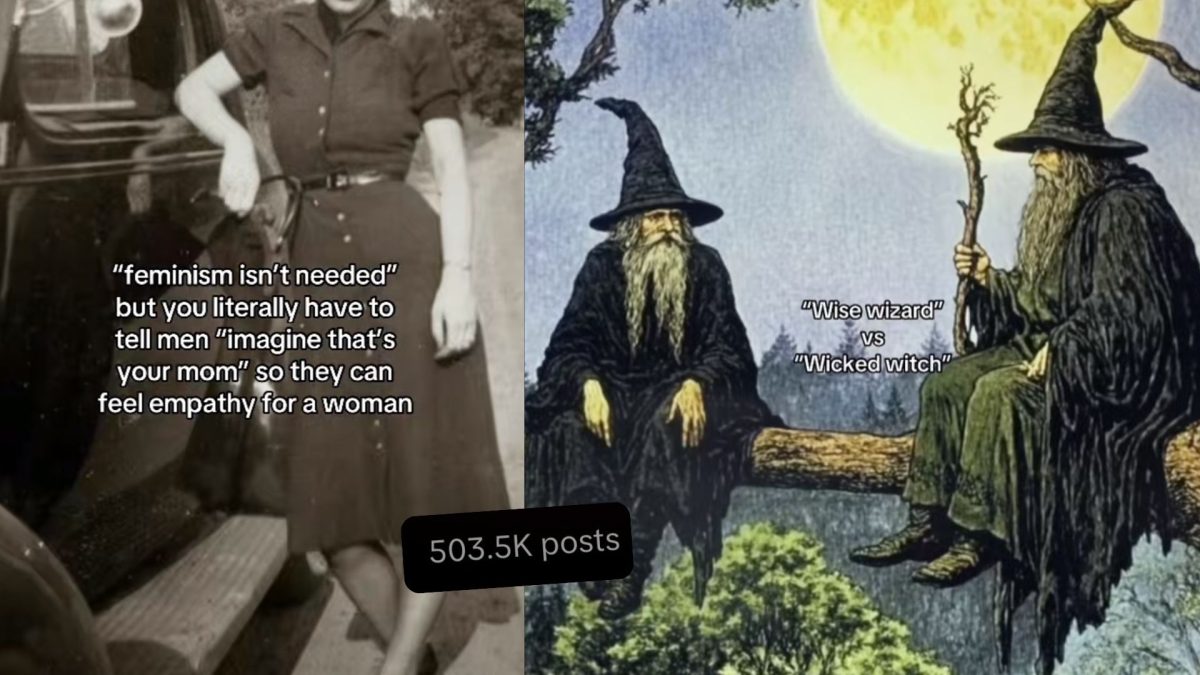
This part of the dialogue was sampled and added to “Alberto Balsalm” by Aphex Twin. Recently, the audio has seen widespread use by creators all over social media, with over 500k videos mostly discussing normalized misogyny and the different pedestals society places men and women on. These videos argue that men are always praised for many of the things they do, if not everything, while women are mocked and dismissed for doing the exact same.

Examples on Social Media

One of the most viral examples is a TikTok video by @theaureliacollins, which has gained over 7.7 million views. It points out that when women scream or show excitement at concerts, they are seen as childish and annoying, while men behaving the same way at sporting events are praised for their “love of the game.”

@theaureliacollins

EDIT: yall im talking abt the double standards in fan culture between women dominated spaces and men dominated spaces 😭 im not ignoring DV that’s just not what im referencing here ~~~ Funny how I’ve been told to grow out of fangirling, but never out of football 🌚 ~~~ #aureliacollins #fyp #fangirl #football #political

♬ original sound – ✰ volt.cc ✰

Another popular video by @quaintfawn, with over 7.6 million views, discusses a similar double standard. It explains that women with neutral facial expressions are often described as having a “resting b*tch face,” while men with the same expression are complimented for having a “smoldering look.”

@quaintfawn

EXPLANATION FOR THOSE WHO ASKED: I was anticipating some discourse to arise surrounding my RBF vs Smouldering look tiktok specifically around the skepticism that the second phrase is even a used term, so to clarify, this is a book centered account, and to those of us who read, the phrases “he had a dark expression”, “smoldering look”, “his face darkened” are very common to come across, and I noticed a distinction in the way language villanizes the emotions of women,even to the minor scale of facial expression and while a “brooding man” Is hot and desirable, and nonchalance is attractive, I thought to myself why is it when me or my friends had a neutral expression, not mad, sad or angry we’d be tagged with the term “RBF” ,so the comparison I’m drawing is the negative vs positive interpretation of male vs female expression I hope this provides some clarity Also a comment inspired me to make another clarification The comment: There is a point here somewhere, but your reasoning is wholly disingenuous, the ‘expression darkened’ and other such descriptors are common for both men and women within traditional books, few, or hardly any of them at all will ever use term ‘resting bitch face’ unironically in prose, you are comparing 2000’s internet slang with actual creative writing descriptions that have been around since the 19th century. My clarification: I’m glad you brought this up the description in the books dose not specifically suggest a gender to those descriptions but it is a larger pattern that I’ve recognized prompting me to want to bridge a discussion, and perhaps the two phrases fall in two different realms, but the message I meant to deliver is landing which is mainly the way that women’s expressions are policed, it is not by any means a clean cut comparison!!! I can admit that, and again this kind of thing can hardly be explored in a 15 second TikTok I would love to engage in a meaningful discussion with all of you And thank you to this user for a valid observation -Writer puddle ✨⛲️

♬ original sound – ✰ volt.cc ✰

The trend has led to broader conversations about gender inequality and the different ways people can be perceived and treated based on gender in everyday contexts. Among some women participating in these conversations, reactions have included a sense of heightened awareness. Some social media users have also shared brief responses reflecting this shift:

“ohhhhh now I’m mad.”

wrote @misamisa8310, gaining over 127K likes.

“i woke up twice today.”

commented @rodrickheffleysmommy, with over 376k likes

“This trend is waking me up.”

said @ruya40995.

The trend remains active across social media platforms and is frequently referenced within broader discussions about gender representation and social perception. It continues to circulate alongside similar content that reflects on social expectations and differences in treatment.

Leave a Reply

Your email address will not be published. Required fields are marked *