
The viral TikTok audio originates from a scene in the 2001 David Lynch film Mulholland Drive, where a character named Dan tells his therapist about a disturbing dream he had involving the diner where they are speaking.
In the dream, both of them are in the diner and feel intimidated. Dan becomes even more frightened when he notices how scared his therapist is. He then says, “Then I realized what it is. There’s a man…”
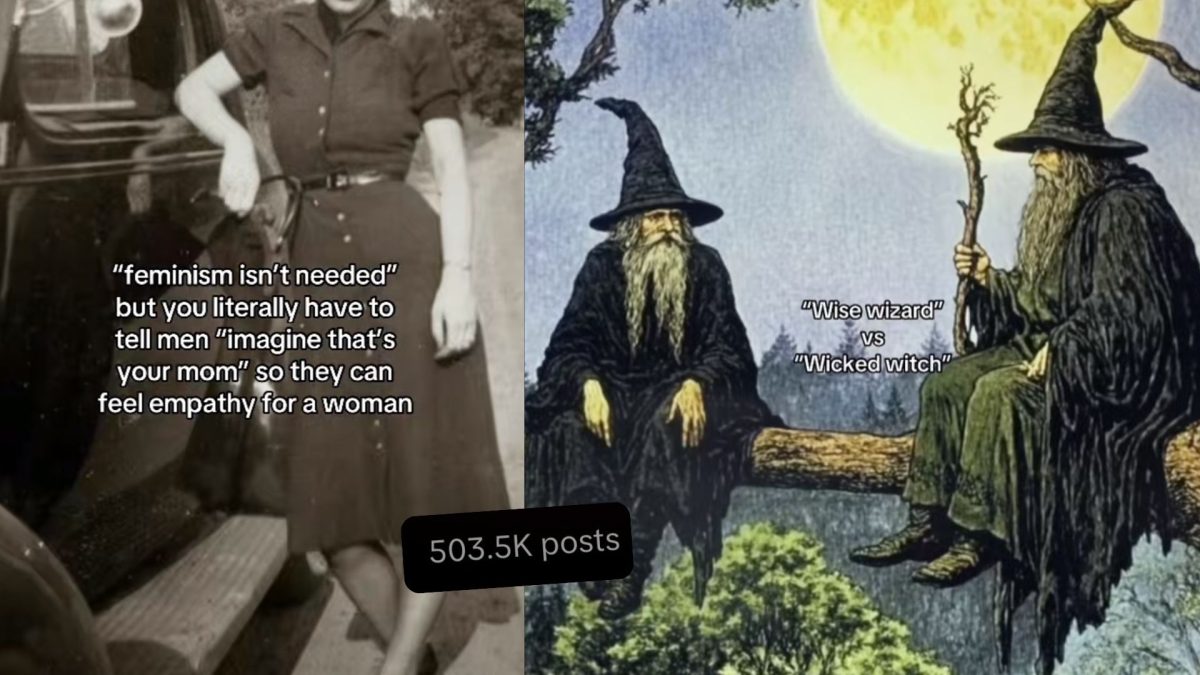
This part of the dialogue was sampled and added to “Alberto Balsalm” by Aphex Twin. Recently, the audio has seen widespread use by creators all over social media, with over 500k videos mostly discussing normalized misogyny and the different pedestals society places men and women on. These videos argue that men are always praised for many of the things they do, if not everything, while women are mocked and dismissed for doing the exact same.
Examples on Social Media
One of the most viral examples is a TikTok video by @theaureliacollins, which has gained over 7.7 million views. It points out that when women scream or show excitement at concerts, they are seen as childish and annoying, while men behaving the same way at sporting events are praised for their “love of the game.”
Another popular video by @quaintfawn, with over 7.6 million views, discusses a similar double standard. It explains that women with neutral facial expressions are often described as having an RBF, while men with the same expression are complimented for having a “smoldering look.”
The trend has led to broader conversations about gender inequality and the different ways people can be perceived and treated based on gender in everyday contexts. Among some women participating in these conversations, reactions have included a sense of heightened awareness. Some social media users have also shared brief responses reflecting this shift:
“ohhhhh now I’m mad.”
wrote @misamisa8310, gaining over 127K likes.
“i woke up twice today.”
commented @rodrickheffleysmommy, with over 376k likes
“This trend is waking me up.”
said @ruya40995.
The trend remains active across social media platforms and is frequently referenced within broader discussions about gender representation and social perception. It continues to circulate alongside similar content that reflects on social expectations and differences in treatment.